
What to Expect When We Come Out
Water damage is stressful, and it helps to know what happens next. This is how a typical job goes in Overland Park and surrounding communities, from your first call to the last moisture reading, and what your options are once everything is dry.
- Moisture readings at every step
- Photos and readings you can share with your insurer
- Equipment comes out when materials are dry
Request a free evaluation
Describe what happened. We will call you back during business hours.
- IICRC Certified & Fully Insured
- Locally owned
- Mitigation and help with repairs
- Help documenting your insurance claim
- Open 7 AM–9 PM, every day
From the first call to a dry home
The same order on every job, adjusted for how much water there was and what it reached.
The first call
We ask what happened, where the water is and whether it’s still running. If it is, we walk you through shutting it off and staying clear of anything electrical.
Then we set a time to come out. We answer 7 AM–9 PM every day, and the evaluation is free.
Arrival
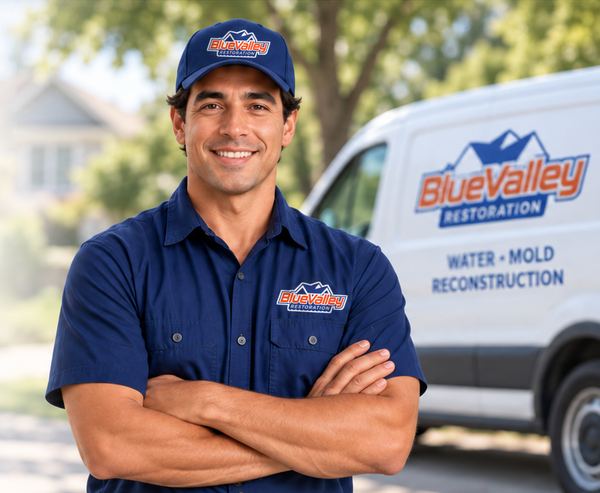
A Blue Valley technician introduces themselves, asks you to show them where the water started and where you’ve seen it, and checks that the source is stopped. If a plumber still needs to fix a pipe, water heater or appliance, we tell you.
Inspection with moisture readings
We take moisture readings at the source and work outward: walls, baseboards, flooring, cabinets and the level below. Water travels farther than it looks, so readings, not appearances, show where materials are wet.
Before any work starts, we explain what we found, what can dry in place and what may need to come out, and why.
Photos and moisture documentation
We photograph the source, each affected area and the readings, and keep notes as the job goes. You can share these records with your insurance company and keep them for your own files.
Drying setup
Standing water comes out first. Then we place air movers and dehumidifiers for the rooms and materials involved. Sometimes baseboards come off or small holes go into drywall so air can reach inside a wall or ceiling.
The equipment is loud and needs to stay on. We’ll tell you how many machines to expect and where they’ll be.
Daily monitoring
We come back to take readings, usually every day or so. As areas dry, we move or reduce equipment, and we log each set of readings with the job photos.


How long drying usually takes
Every home is different. These are typical ranges, not promises.
| What got wet | Typical drying time |
|---|---|
| Carpet, pad and drywall after a recent leak | Often 3 to 5 days once equipment is running |
| Hardwood floors, framing and plaster | Often a week or more |
| Larger losses, or water that sat for a while | Can take longer; we’ll tell you what the readings show |
How much water there was, what it soaked into, how long it sat and the conditions in the home all change the timeline. We remove equipment when readings say materials are dry, not on a fixed schedule. See how structural drying works.
Working with your insurance company
Most claims start with a call to your insurer. Here’s how we fit in.
- Your insurance company decides what’s covered. We can’t promise coverage or approval.
- We document the loss: photos, moisture readings and notes from the first visit to the last.
- We prepare restoration estimates where appropriate and answer your adjuster’s questions about the drying.
- In most cases you can choose your own restoration company. Check your policy or ask your agent if you’re unsure.
Questions about coverage? Our guide Does homeowners insurance cover water damage? explains the common situations.
We’ve worked with claims from these carriers
We work with any insurance company. Logos are trademarks of their owners and don’t imply a partnership or endorsement.











Once it’s dry: rebuild options
Drying is done when the readings say so. Then you decide what happens next.
- If drywall, flooring, trim or cabinets had to come out, we can help with the repairs. See water damage repair.
- You’re also free to use your own contractor. We share our photos and readings so they know what was removed and why.
- Nothing gets closed up until final readings confirm the structure is dry.

Questions about the process
Straight answers. If your situation is different, call and describe it.
Do I need to be home while you work?
Someone needs to let us in for the first visit and walk us through what happened. For the monitoring visits, we can usually work around your schedule.
Can I turn the drying equipment off at night?
Please don’t. Turning it off slows drying. If the noise is a problem in a bedroom, tell us and we’ll talk through options.
Will you have to cut into my walls?
Only when readings show a wall or ceiling won’t dry otherwise. Often it’s baseboards off or a few small holes. We explain before we cut anything.
What is the free evaluation?
We look at the damage, take readings, explain what we see and talk through next steps before any work starts.
Do you fix the leak?
No. A plumber repairs the pipe, water heater or appliance. We handle the water damage it left behind: extraction, drying, readings and documentation.
When will I know it’s dry?
When readings on the affected materials match normal readings for the same materials in a dry part of your home. We share the final readings with you.
Talk to our restoration team
Call and describe what happened. We will tell you what to do right now and set up a free evaluation.
Open 7 AM–9 PM, every day. Form requests receive a call back during those hours.
Our locations
- Leawood15275 Metcalf Ave
Overland Park, KS 66223 - Olathe2012 E Prairie Cir, Unit C
Olathe, KS 66062 - Overland Park8400 W 127th St, Unit 12
Overland Park, KS 66213
Request a free evaluation
Describe what happened. We will call you back during business hours.