
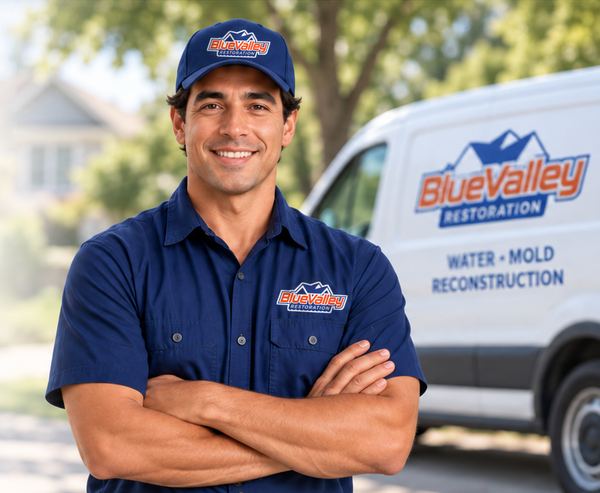
Blue Valley Restoration technician standing in front of a branded service van

Water Damage Restoration in Overland Park, KS

Water from a burst pipe, a leaking water heater or a failed supply line rarely stays where you can see it. We find where it went, dry it properly and document everything for your insurance.

Blue Valley Restoration technician standing in front of a branded service van
  • Moisture readings, not guesses, for walls, floors and framing
  • We dry materials in place when they can be saved
  • Help documenting your insurance claim

Request a free evaluation

Describe what happened. We will call you back during business hours.

By submitting, you agree to our Privacy Policy.

We return calls during business hours, 7 AM–9 PM every day. For immediate help, call (913) 395-8488.

  • IICRC Certified & Fully Insured
  • Locally owned
  • Mitigation and help with repairs
  • Help documenting your insurance claim
  • Open 7 AM–9 PM, every day
Do this first

If water is in your home now

You don’t need to fix anything yourself. These steps keep you safe and keep the damage from spreading while you get help.

  • Stay out of water near electricity.If water is near outlets, cords, a furnace or anything plugged in, stay out of that area. Don’t touch anything electrical or reach for the breaker panel through water. Call us, your electric utility or an electrician first.
  • Shut off the water if you can do it safely.The main shutoff is usually where the water line enters the house, often in the basement. Toilets, sinks and washers usually have their own valve too.
  • Don’t touch water that may be contaminated.If the water came in from outside, from a floor drain or from a toilet bowl, keep your hands off it and keep kids and pets away.
  • Take photos and video.Before anything is moved or thrown out, photograph the water, the source and anything damaged. Your insurance company will ask for them.
  • Move what you can reach safely.Lift rugs, electronics, photos and boxes off wet floors, but only if you don’t have to walk through water near anything electrical.
  • Don’t use a household vacuum.Regular vacuums aren’t built for water and can be a shock hazard. Leave extraction to equipment made for it.

Then call Blue Valley at (913) 395-8488. We’ll ask where the water came from and how much there is, and tell you what happens next.

Our process

What Blue Valley does when we get there

Every job is different, but the work happens in the same order. We explain each step before we do it.

  1. 01

    Inspect

    We trace the water and meter what’s wet, even behind walls.

  2. 02

    Extract

    Standing water comes out of carpet, pad and floors.

  3. 03

    Dry

    Air movers and dehumidifiers, placed by the readings.

  4. 04

    Document

    Photos and moisture readings for your insurance claim.

  5. 05

    Restore

    Help with repairs once readings confirm it’s dry.

The steps in more detail

  1. Find every affected area

    We trace the water from the source and mark everything it reached, including the next room and the level below.

  2. Extract standing water

    We pull water out of carpet, pad and hard floors so drying can start.

  3. Check for hidden moisture

    Moisture meters show what’s wet behind baseboards, under flooring and inside walls, even when the surface feels dry.

  4. Remove what can’t safely stay

    Soaked pad, swollen trim or drywall that won’t dry in place comes out. We remove only what we need to and tell you why.

  5. Set up drying and dehumidification

    Air movers and dehumidifiers are placed for the room, the materials and how much water there was.

  6. Monitor moisture until it’s dry

    We take readings during the job and adjust the equipment until materials are back to normal moisture levels.

  7. Document the loss

    Photos, moisture readings and notes for your records and for your insurance company.

  8. Repairs when they’re needed

    If drywall, flooring or trim has to be replaced, we can help with that too. See water damage repair.

Dehumidifier and several air movers drying carpet in a finished basement after a sump pump failure in Lee’s Summit, MO
Drying equipment in a finished basement after a sump pump failure (a Blue Valley job in Lee’s Summit, MO).
Air movers drying a basement floor beside a water heater in Prairie Village, KS
Air movers drying a basement floor next to the water heater (Prairie Village, KS).
Local know-how

Water damage in Overland Park homes: what we commonly see

Overland Park has a little of everything, from 1950s ranches to houses built in the last few years. A home’s age and layout change where water goes and how it needs to be dried. This is what we commonly see on our jobs, not a rule for every street.

Older homes in north Overland Park

Roughly north of I-435, in ZIP codes like 66204, 66207 and 66212, many homes are ranches and split-levels from the 1950s and ’60s, often with block basement walls, original floor drains and plumbing that’s been patched over the years. We commonly see seepage along basement walls after long rains, water around floor drains, and leaks from aging supply lines and water heaters.

Newer homes in south Overland Park

South of 119th Street, in 66213, 66221 and 66223, homes are generally newer, usually with finished basements, a sump pit and a second-floor laundry room. Common calls there are sump pumps that fail during spring storms, window wells that fill up, and upstairs washers or bathrooms leaking into the ceiling below.

Finished basements

Carpet, pad, drywall and trim soak up water quickly, and drywall wicks it upward from the floor. Drying usually means pulling baseboards, checking the bottom of the walls with a meter and sometimes cutting drywall a few inches up so the wall cavity can dry.

Sump pumps

Pumps fail from power outages, stuck float switches, worn motors or more water than they can keep up with. Carpet and pad over concrete stay wet underneath long after the surface looks fine, so a basement rarely dries by just “airing out.”

Appliance leaks

Washers, dishwashers, refrigerator ice-maker lines and upstairs laundry rooms. The leak is often small, but it runs under flooring and cabinets for a while before anyone sees it.

Water heaters

Most sit in a basement or utility closet right next to finished space. A tank that leaks slowly can soak the bottom of nearby walls and carpet before it’s noticed.

Frozen pipes

When temperatures drop, pipes in exterior walls, unheated garages and over crawl spaces are most at risk. The leak often shows up when the pipe thaws, not when it freezes.

Hardwood floors

Wood takes on water from below and starts to cup. If drying starts early, many floors can be dried in place instead of torn out, like the kitchen floor in the project below. See how hardwood floor drying works.

Real jobs, real photos

Recent Overland Park projects

Two recent Blue Valley jobs in Overland Park. We don’t share customer names or addresses.

Floor-mat drying system with yellow hoses and a dehumidifier drying cupped hardwood floors in an Overland Park, KS kitchen
Close-up of drying mats taped to wet hardwood flooring during water damage drying in Overland Park, KS
Dehumidifier display showing temperature and humidity readings while drying hardwood floors in Overland Park, KS
Overland Park, KS · Hardwood floors

Cupped hardwood floors dried in place

What happened
Water got under the hardwood flooring in and around the kitchen.
What we found
The boards were wet and badly cupped, with the edges raised as the wood took on moisture.
What we did
Instead of tearing the floor out, we set up a floor-mat drying system: panels taped to the hardwood and connected by hoses that pull moisture out of the wood, with dehumidifiers running alongside.
Outcome
The floor was dried in place, and we tracked progress with moisture and dehumidifier readings throughout the job.
Day 1: interior wall opened to the framing around a window after water got into the walls, Overland Park, KS
Day 2: the same wall the next day with new sheathing in place, Overland Park, KS
Day 1: wall opened Day 2: same wall
Overland Park, KS · Water inside walls. The same wall photographed a day apart. Drag the handle to compare.
Overland Park, KS · Water inside walls

Water in the walls of a newly bought home

What happened
Water was getting into the walls of a house the owners had recently bought.
What we found
Moisture testing showed water coming in around the windows and through some of the siding, wetting the framing inside the walls.
What we did
We opened the affected walls to expose the framing so it could dry, and documented what we found.
Outcome
With the walls open, the framing could dry out and the problem areas around the windows and siding were visible for repair.
Insurance

Help with your insurance claim

Most water damage claims start with a call to your insurance company. We help with what comes next: showing what got wet, how wet it was and why the work is needed.

  • We document the loss with photos, moisture readings and notes from the first visit.
  • We prepare restoration estimates where appropriate, so your adjuster can see the scope of work.
  • We work with your adjuster and answer their questions about the drying and repairs.
  • We explain what we’re seeing in plain language, so you know what to ask your insurer.

Coverage depends on your policy and the cause of the damage, and your insurance company makes that decision. We can’t promise what will be covered, but we can make sure the damage is clearly documented.

Dehumidifier display showing inside and outside humidity readings recorded during water damage drying
Readings like these go into the drying records we keep for your claim (from a Blue Valley job in Lee’s Summit, MO).

Why Overland Park homeowners call Blue Valley

No big promises. Just the things you can check.

  • IICRC Certified & Fully Insured

    Our team is trained in water damage restoration, and we explain the drying process in terms you can follow.

  • Locally owned

    We’re a local company working in Overland Park and the cities around it, not a national franchise.

  • Help with repairs, too

    We handle the drying, and if repairs are needed once the equipment is gone, we can help with that too.

  • Decisions based on readings

    We measure moisture instead of guessing, and we dry materials in place when they can be saved, like the hardwood floor above.

  • Help documenting your claim

    Photos, moisture readings and estimates your adjuster can use.

  • Open every day

    We answer 7 AM–9 PM, seven days a week, including weekends.

Water damage questions from Overland Park homeowners

Straight answers to common questions. If your situation is different, call and describe it.

How quickly does water damage need to be dried?

As soon as possible. Water keeps soaking into drywall, wood and flooring as long as it sits, and the EPA recommends drying wet materials within 24–48 hours to help prevent mold growth. Once equipment is set up, most homes take several days to dry completely. Dense materials like hardwood and framing take longer than carpet or drywall. We use moisture readings to confirm materials are actually dry, not just dry to the touch.

Can wet drywall be saved?

Sometimes. If clean water reached it and the drywall hasn’t swollen, crumbled or sagged, it can often be dried in place. Drywall that’s soft, has insulation soaked behind it, or has been wet for a long time usually needs to be cut out a few inches to a couple of feet up from the floor so the wall cavity can dry. We check it with a moisture meter before deciding.

How do I know if there’s water behind a wall?

Look for bubbling or peeling paint, swollen baseboards, stains, a musty smell or drywall that feels soft. Often there’s nothing you can see. A moisture meter can tell from the surface whether the inside of the wall is wet. That’s how we found water around the windows on the Overland Park project above.

Can hardwood floors be saved after a leak?

Often, if drying starts early. Cupping, where the edges of each board sit higher than the center, means the wood took on moisture from below. A floor-mat drying system pulls that water out with the floor still in place. Whether boards flatten on their own, need sanding and refinishing, or need to be replaced depends on how long they were wet and the type of flooring. We’ll tell you what we see.

Should I call my insurance company or a restoration company first?

If water is still spreading, deal with that first. Most policies expect homeowners to take reasonable steps to stop further damage. Then report the claim to your insurance company. We document the damage from the first visit, which helps no matter which call you make first. If you’re not sure whether to file a claim, ask your agent.

Does homeowners insurance cover water damage?

It depends on your policy and the cause. Many policies cover sudden, accidental water damage, like a burst pipe or a failed supply line. Long-term leaks, groundwater and sump pump failures may be excluded or need a separate endorsement. Your insurance company makes the final decision. We document the damage and the cause so your adjuster has what they need.

Does wet carpet have to be thrown out?

Not always. Carpet that got wet with clean water and is dried quickly can often be saved. The pad underneath holds the most water and is commonly replaced. Carpet is more likely to go if it stayed wet for days, if the water may be contaminated, or if the backing is separating.

My sump pump failed. What should I do?

Stay out of the water if it’s anywhere near outlets, cords or appliances, and don’t try to work on the pump while standing in water. Take photos, move what you can reach safely, and call us. Once it’s safe, a plumber can get the pump working again so more water doesn’t come in while the basement dries.

Serving Overland Park and nearby cities

We also work in Leawood, Olathe, Lenexa and Prairie Village, plus the other cities below. See how our water damage restoration process works across the area.

ShawneeMissionPrairie VillageLenexaLeawoodOlatheLee’s SummitOverland Park

Call our restoration team

Call about water in your Overland Park home. We’ll ask what happened, tell you what to do right now and set up a time to look at it.

(913) 395-8488

Open 7 AM–9 PM, every day. Requests sent through the form get a call back during those hours.

Serving Overland Park from our Overland Park location

8400 W 127th St, Unit 12
Overland Park, KS 66213

Request a free evaluation

Describe what happened. We will call you back during business hours.

By submitting, you agree to our Privacy Policy.

We return calls during business hours, 7 AM–9 PM every day. For immediate help, call (913) 395-8488.

Call (913) 395-8488 Free evaluation